What was announced or recorded
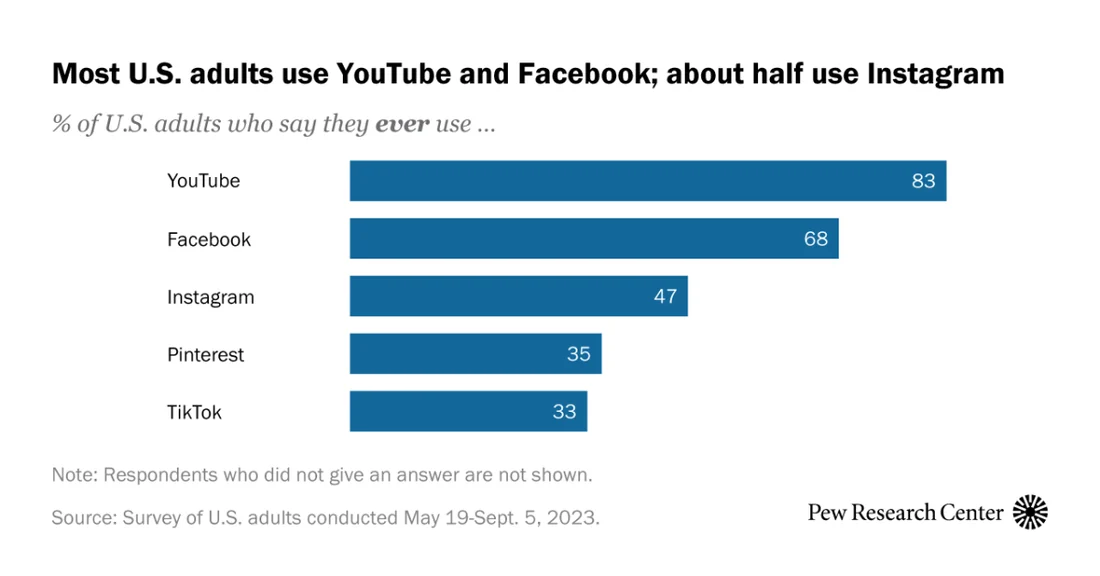
On 31 January 2024, the Pew Research Center published Americans' Social Media Use, a survey report on which platforms US adults say they use. Pew states it surveyed 5,733 US adults between 19 May and 5 September 2023, drawn from the American Trends Panel, an address-based, non-opt-in recruitment design intended to represent the adult population rather than a self-selecting online sample.
What the documents establish
The report states that 83% of US adults say they use YouTube, 47% say they use Instagram, and 33% say they use TikTok. Broken down by age, it records that 62% of adults aged 18 to 29 say they use TikTok, against 10% of adults 65 and older, a 52 percentage-point gap on Pew's own figures; the equivalent Instagram gap is smaller, 78% against 15%. These are self-reported platform use figures, meaning 'use' is whatever a respondent understood the word to mean, not a logged visit or a minutes-watched count; Pew asks whether someone uses a platform, not how they use it, so the survey cannot say what share of TikTok users are watching vertical drama clips as opposed to anything else on the platform.
Announced versus delivered
There is no plan here to compare against a result; the report is a completed measurement of stated behaviour at one point in 2023, published with a lag into 2024. What it delivers is a reliable age profile of who says they use which named platform; what it does not deliver is any content-level detail, so a claim that 'young adults watch vertical drama' cannot be supported from this document alone, only the narrower, verified claim that young adults are far more likely to say they use TikTok and Instagram than older adults are.
What to watch
Editorially, the figure to watch is whether Pew's next wave shows the TikTok age gap narrowing or widening, since a narrowing gap would be the first population-level sign that a format built for a younger TikTok audience is reaching older viewers too, an inference the platform-use question alone cannot support until it happens.
- Is a platform-use percentage measuring simple use, or a specific behaviour such as watching drama content?
- Does the survey's sampling method make it representative of a wider population, or only of people willing to join an online panel?
- Is the age breakdown being applied to a claim about content the underlying question never asked about?
Pew's probability sample makes the platform-use figures durable evidence of who uses TikTok and Instagram, and by how much more than older adults; it says nothing about what any of them are watching there, and any drama-specific claim built on top of it is the analyst's addition, not Pew's finding.
Sources & evidence
www.pewresearch.org · Official source
Source date: 31 Jan 2024 · Checked: 16 Sept 2026
- States survey method, sample size, fieldwork dates, and the platform-use percentages by age for YouTube, TikTok and Instagram.
www.pewresearch.org · Official source
Source date: Not stated by source · Checked: 16 Sept 2026
- Pew's own description of the address-based, non-opt-in panel recruitment underlying the survey's claim to represent the adult population.